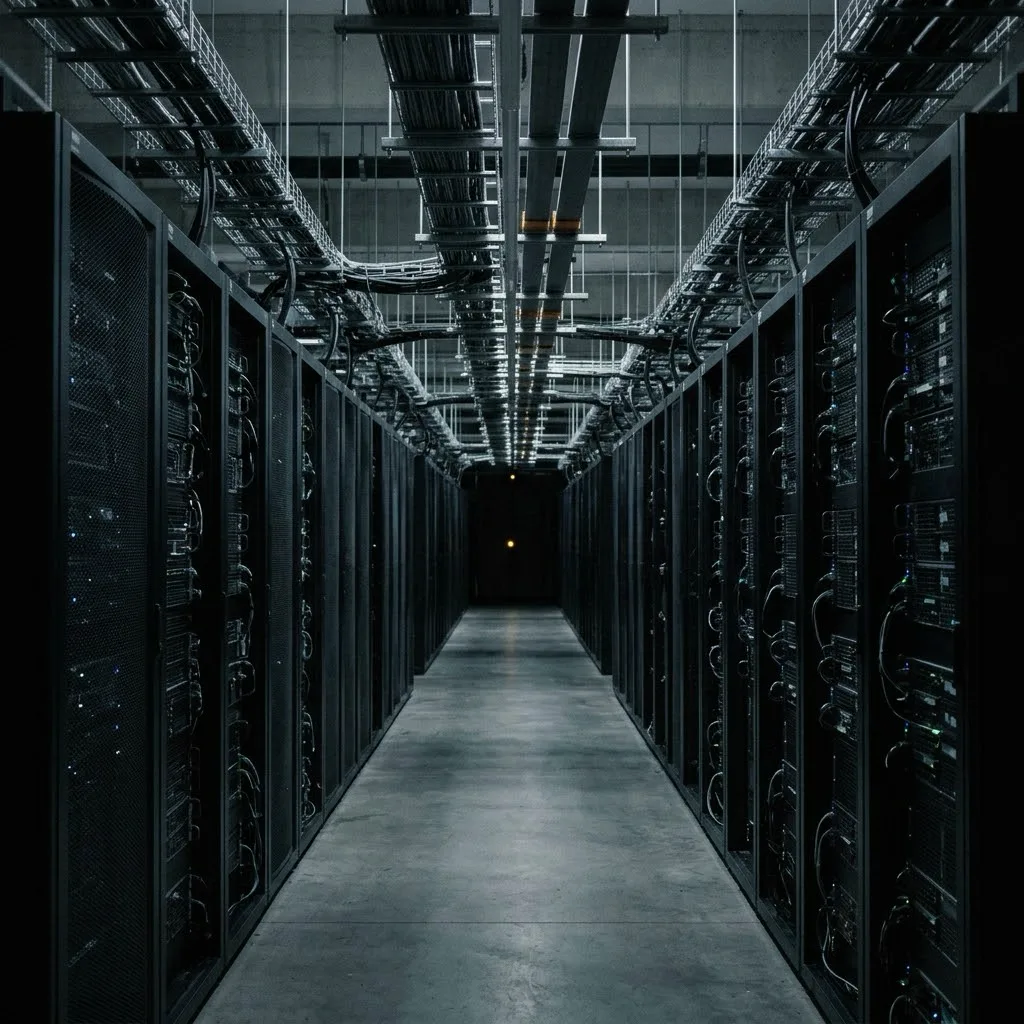
If your organisation plans to run AI at scale, the number worth your attention in SpaceX's latest results is 1.7 gigawatts. That is the computing capacity the company owns today, and its largest revenue line now rests on it.
In short: On 20 October SpaceX reported third-quarter 2026 results. Revenue was $14.6 billion, of which $7.56 billion came from the AI segment it inherited when it merged with xAI in February. Its compute tenants include Anthropic, at about $1.25 billion a month, and Google, at about $920 million a month.
What does a gigawatt of computing mean?
The basic unit in these centres is a rack of 72 Nvidia Blackwell GPUs that work as one machine and draw about 132 kilowatts. One gigawatt is therefore about 7,600 racks and about 545,000 GPUs. Colossus 2 holds 550,000 GPUs, so its computing load alone is about one gigawatt on our arithmetic.
Heat: water or electricity?
Every watt that enters a chip leaves as heat. Each rack needs about 190 litres of water a minute circulating in a closed loop to carry its heat away at a 10-degree rise. The heat then leaves the building one of two ways: evaporative towers that consume at least 35,000 cubic metres of water a day per gigawatt, or air-cooled chillers that use almost no water and more electricity. At Colossus 2, xAI chose the second: 119 air-cooled chillers with about 200 megawatts of cooling as of August 2025, according to SemiAnalysis.
Power: a plant before the grid
Colossus 2 is not connected to the public grid. According to Cleanview's analysis of satellite images, it runs on about 59 mobile gas turbines totalling about 1.3 gigawatts until a permanent plant of about 1.2 gigawatts, permitted in March 2026, is finished. Tesla Megapack batteries sit between the turbines and the racks, because training draws power in synchronised swings: all the chips compute together, then wait together to exchange results. Turbines do not tolerate those load steps, so the batteries absorb them.
Network: 100,000 GPUs as one machine
In Colossus 1, Nvidia's Spectrum-X links 100,000 GPUs on a single Ethernet fabric that delivers 95% of its capacity in practice. Ordinary Ethernet reaches about 60% at that size, because data flows collide. What matters: the AI segment made $431 million of operating profit on $7.56 billion in the third quarter, a margin of about 5.7%, while the company spent $19.6 billion on investment in the same quarter. Renting compute is a utility business: huge capital, a thin margin, and the winner is whoever has the cheapest power and builds fastest.
And the Kingdom?
SpaceX's 1.7 gigawatts alone is close to four times all the data-centre capacity installed in the Kingdom, which Alvarez & Marsal puts at about 410 megawatts. In November 2025 HUMAIN and xAI announced a centre of more than 500 megawatts whose first cluster is 18,000 GB300 GPUs: about 250 racks at about 140 kilowatts each, so about 35 megawatts on our arithmetic, roughly 7% of the announced capacity.
The Kingdom's edge in this equation is power. The Saudi Power Procurement Company signed the Afif solar contracts at 0.047 riyals per kilowatt-hour, about 1.25 US cents. A one-gigawatt centre running all year uses 8.76 terawatt-hours, which costs about $110 million at that price and about $440 million at 5 cents. Solar needs storage or firm supply to run at night, so the real price for a constant load is higher.
Where to start
Start with three questions, in order: how many megawatts your programme needs over three years, where its power and water come from, and in which city its data is processed. The answers show whether to build or rent.
This analysis comes from research by the Horizon Studio RDI Center. We checked every figure at its source, and we say so where a number is our own calculation.
To assess your programme's readiness: horizon.bishernp.com/ministries
References
SpaceX, third-quarter 2026 results, 20 October 2026.
SpaceX, IPO registration filing with the US Securities and Exchange Commission, June 2026.
Elon Musk, posts on X about the Colossus centres, September 2026.
Vertiv and NVIDIA, GB200 NVL72 reference design, October 2024.
NVIDIA, Spectrum-X networking at Colossus, October 2024.
HUMAIN and xAI, data centre announcement, November 2025.
Alvarez & Marsal, estimate of Saudi data-centre capacity, August 2026.
Saudi Power Procurement Company, solar power purchase agreements, July 2025.
Kimi K3 from the inside. What it takes to run it yourself
Planning to run the Kimi K3 model? This report analyzes its MoE architecture, true operational costs, and data localization readiness in Saudi Arabia to guide your decision.
Who owns Saudi space? A map of the sector in 2026
Working in Saudi Arabia's space sector in 2026 requires understanding its structure. This guide maps out the key players: the regulators, builders, PIF funders, and service providers like Starlink.
Orbital data centres: Why radiators decide before solar
Explore how orbital AI data centres tackle heat, radiation, and launch costs, and how Saudi solar and space assets fit into the equation.