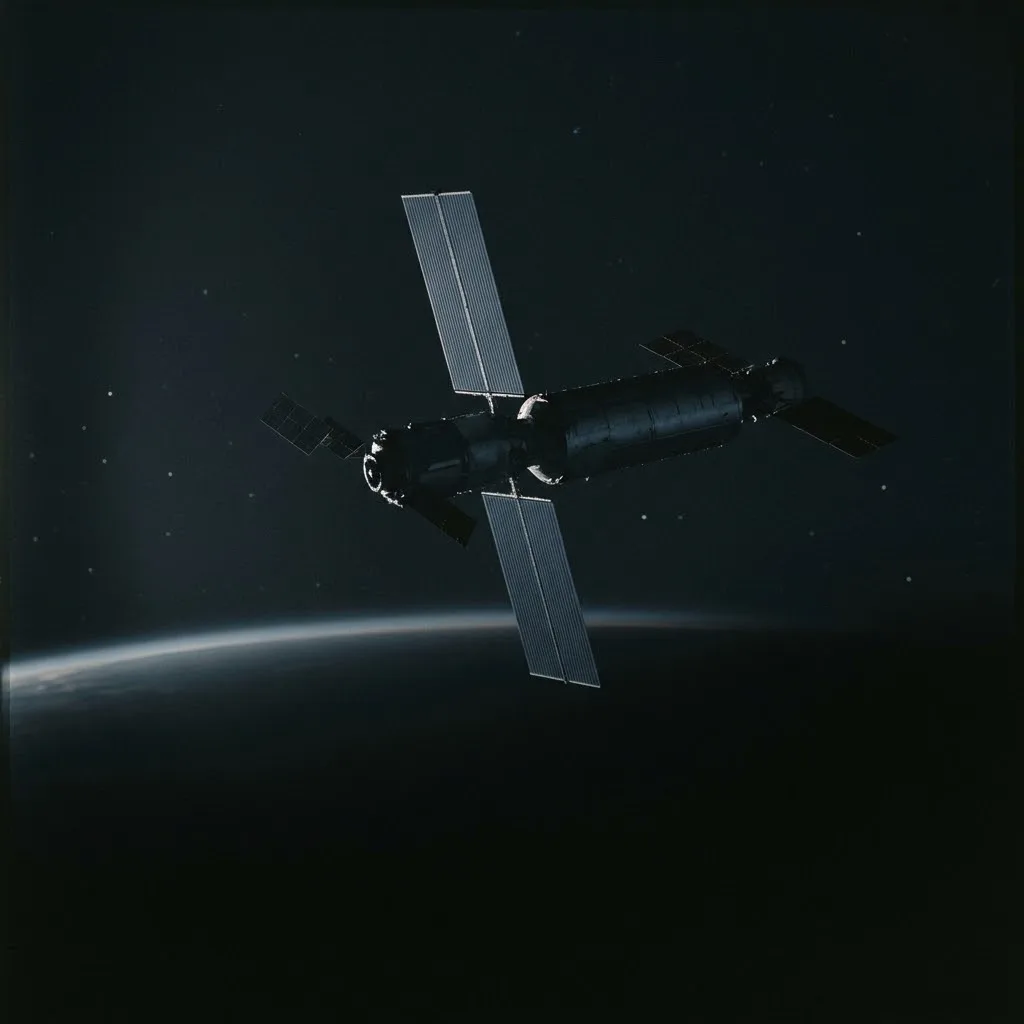
If you invest in AI infrastructure, you will meet the idea of data centres circling the Earth this year. The engineering question that decides it is simpler than it looks: how do you get rid of heat where there is no air and no water?
In short: In early October 2026 Google and Planet launched the first satellite of Project Suncatcher. It carries 4 TPUs and runs Gemma in 15-minute sessions, because heat limits it. SpaceX published its AI1 satellite design with 150 kilowatts of peak compute. In China, the Three-Body constellation has been running since 2025, and according to Tech Times, two of its satellites held a laser link for 192 hours without a break in July 2026.
1. Heat first
In a vacuum, heat leaves only by radiation, and the Stefan-Boltzmann law sets how much: radiated power equals emissivity × a constant × area × absolute temperature to the fourth power. On our arithmetic, one megawatt at 27°C needs about 2,400 square metres of single-sided radiator, and at 77°C about 1,300 square metres. Fifty degrees more cuts the area by about 46%, because of the fourth power.
That is why designers run the coolant as hot as the chips allow. The AI1 design uses 110 square metres of radiator rejecting about 1,400 watts per square metre from both faces, about 154 kilowatts. Working backwards, the radiator surface runs near 69°C on our arithmetic, and the performance per square metre is about eight times that of the International Space Station's radiators.
2. Sunlight second
Above the atmosphere, 1,361 watts arrive on each square metre. In a dawn-dusk orbit a panel stays in sunlight almost all year, receiving about 11,900 kilowatt-hours per square metre annually. Google says a panel there produces up to eight times what it does on Earth, a comparison with mid-latitude sites. In the Kingdom, where irradiance is 2,000 to 2,450 kilowatt-hours, the advantage is about five to six times.
3. Radiation third
Google tested its chip in a proton beam. Its HBM memory showed errors after a dose of 2 krad, the logic had no hard failures up to 15 krad, and the expected shielded five-year dose is about 0.75 krad. Memory is the weak link, and inference tolerates an occasional flipped bit far better than training. That is why orbital computing starts with inference.
4. Distance fourth
Training moves enormous amounts of data between chips, and the power an optical receiver collects falls with the square of distance, and capacity falls with it. Google's design therefore places 81 satellites in a cluster one kilometre in radius, 100 to 200 metres from their neighbours, and reached 1.6 terabits per second in the lab with a single transceiver pair.
5. Price last
Launch cost per kilowatt of compute = price per kilogram × 1,000 ÷ kilowatts per tonne. SpaceX targets more than 100 kilowatts per tonne. If launch falls to $200 per kilogram, a kilowatt costs about $2,000 to launch, close to five years of electricity at 5 cents. Google's threshold rests on that: under $200 per kilogram by the mid-2030s.
And the Kingdom?
Here the arithmetic changes. Five years of power at the Afif solar price of 1.25 cents is about $550 per kilowatt. For orbit to beat our desert on energy cost alone, launch must fall to about $40 to $55 per kilogram on our arithmetic, before radiators, shielding and the impossibility of repair.
The Kingdom has two seats in this story. The Saudi Space Agency's Shams satellite has measured radiation between 500 and 70,000 kilometres since April 2026, exactly the data anyone designing orbital computing needs. And HUMAIN invested $3 billion in xAI, now part of SpaceX, so it holds a share of SpaceX's orbital bet.
The question for an investor: which number falls faster, the price of launch or the price of sunlight on the ground?
This analysis comes from research by the Horizon Studio RDI Center. We checked every figure at its source, and we say so where a number is our own calculation.
To request the sector brief: horizon.bishernp.com/capital
References
Google Research, Project Suncatcher, 4 November 2025.
NPR, launch of the first Suncatcher prototype, 1 October 2026.
SpaceX, AI1 satellite design, June 2026, as reported by DCD and Tom's Hardware.
SpaceX, application to the US Federal Communications Commission, 30 January 2026, and IPO filing, June 2026.
Tech Times, laser link in the Three-Body constellation, September 2026.
Awan et al., solar resource in Saudi Arabia, Sustainability, 2018.
Saudi Power Procurement Company, solar power purchase agreements, July 2025.
Who owns Saudi space? A map of the sector in 2026
Working in Saudi Arabia's space sector in 2026 requires understanding its structure. This guide maps out the key players: the regulators, builders, PIF funders, and service providers like Starlink.
Kimi K3 from the inside. What it takes to run it yourself
Planning to run the Kimi K3 model? This report analyzes its MoE architecture, true operational costs, and data localization readiness in Saudi Arabia to guide your decision.
A gigawatt of computing. What SpaceX built to rent out
SpaceX reported Q3 2026 results, and its largest revenue unit runs on 1.7 GW of compute. What one gigawatt demands in water, power and networking, and where the Kingdom stands.